Back to Prices
Arundinaria gigantea 'French Lick'
This will be offered in limited quantities only for our first time during the 2026 / 2027 season.
Maximum height: 7-8 ft.
Maximum diameter: .25 in.
Minimum temperature: -15ºF: Zones 5a/5b-10b
(The roots are at least 10ºF more hardy.)
Digging Season: Late October through December, or until the ground freezes.
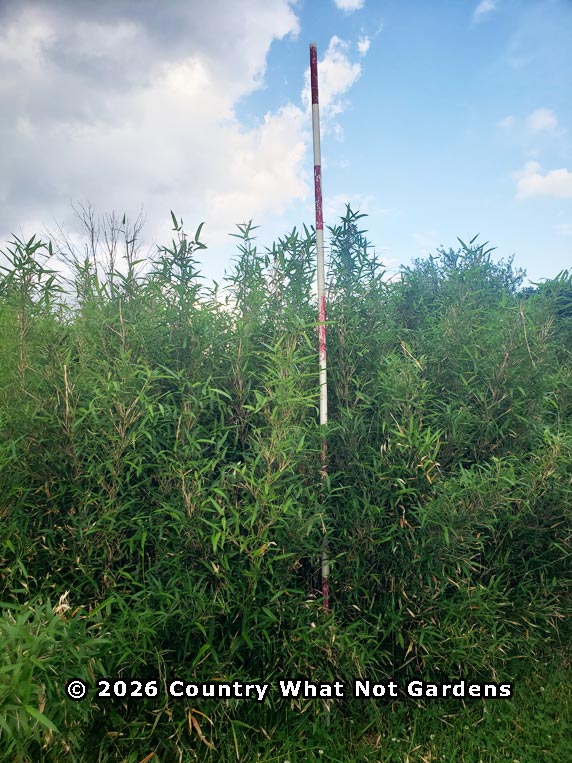
Native Indiana Northern Bamboo
Provenance & Trial History: This unique ecotype was originally gifted to us more than 20 years ago from an intact, wild native canebrake on private property in French Lick, Indiana. Evaluated for over two decades on our 20-acre property with separate groves of a southern selection and the 'Macon' ecotype, 'French Lick' has proven itself to be a distinct and highly stable northern variation.
While it initially exhibited a longer establishment phase and less winter hardiness than 'Macon' in its youth, this clone has fully acclimatized over the last several winters. Now that the grove has achieved mature underground rhizome biomass, its cold hardiness has caught up, proving itself to be rock-solid in our Midwestern climate. It reliably exhibits a compact, manageable mature height of roughly 7 to 8 feet (compared to the 12–15+ feet of 'Macon') and fills spaces rapidly via a vigorous rhizome system faster than ‘Macon’. This makes it an unparalleled native choice for dense, low-profile privacy screens and ecological restoration projects in northern zones.
The Ecological History of the Indiana Canebrakes
While native canebrakes (Arundinaria gigantea) are considered a critically endangered ecosystem today—having declined by over 98% since European settlement—they were once a defining feature of Central and Southern Indiana's natural landscape.
The Buffalo Trace Connection
During the 18th and early 19th centuries, the native bamboo range extended well into the heart of the state. Giant cane flourished reliably along the major river drainage basins, tracking north along the Wabash and White River systems as far north as modern-day Indianapolis.
The region surrounding the natural mineral springs and salt licks of French Lick was a major hub for the American Bison. Millions of migrating buffalo traveled along the Buffalo Trace (or Vincennes Trace), a wide overland highway cutting across Indiana. Pioneer journals, military dispatches, and early land surveys document that the lowlands, creek terraces, and river basins across mid-to-southern Indiana were flanked by massive, nearly impenetrable stands of giant cane.
Because river cane retains its green, nutrient-rich foliage throughout the sub-zero winter months, it served as the primary winter forage sustaining the massive historic bison herds. This striking natural landscape left a deep impression on early settlers, eventually weaving its way directly into the regional folk music of the American frontier:
"Then we'll rally 'round the canebrake and chase the buffalo"
—is preserved in Leah Jackson Wolford's landmark 1916 historical study, The Play-Party in Indiana, published by the Indiana Historical Commission.
As agricultural land-clearing, fire suppression, and heavy livestock grazing accelerated through the mid-1800s, these magnificent ancient canebrakes virtually vanished from Central and Southern Indiana, leaving behind only rare, isolated genetic remnants on undisturbed private lands.
Historical References & Sources
• The Buffalo Trace & Forage Records: Historical documentation regarding the migration of bison along the Vincennes/Buffalo Trace and their reliance on the dense winter canebrakes surrounding the southern Indiana mineral licks is preserved through the U.S. Forest Service / Hoosier National Forest Heritage Center ("The Buffalo Trace Story").
• Early Pioneer & Historical Accounts: Early traveler narratives, geographic descriptions, and early land surveys detailing the abundance of Arundinaria along the Wabash, White, and Patoka River drainage systems across Central and Southern Indiana are archived by the Indiana Historical Society and The Filson Historical Society (e.g., John Filson's late-18th-century regional frontiersman accounts).
• Ecosystem Decline Status: Data regarding the historical distribution and subsequent 98% structural decline of native North American Arundinaria gigantea communities is sourced from the USDA Forest Service Fire Effects Information System (FEIS) and NatureServe Explorer ecological vulnerability databases.