Trait Selection Standard for Breeding Onagadori Traits I previously used my own standard to breed my fowl by until a friend translated the full Japanese standard for me.
There are currently no known Onagadori in the US; "American Onagadori" or otherwise. The "American Onagadori" is a falsehood often advertised by its proponents with stolen images from breeders of real Onagadori in other countries. What they advertise is not what they sell.
There are currently no known Onagadori in the US. The so-called "American Onagadori" are Phoenix that only rarely produce a partially non-molting bird as a fluke and do not readily reproduce more non-molting offspring after themselves. An Onagadori is in fact only a breed in which the males do not molt the tail and saddle feathers for at least three to four years and remains growing during that time. The Phoenix is itself a nice breed, but is not and should not be confused with the Onagadori.
Even the Japanese did not refer to their non-molting fowl as Onagadori until the fowl reached the current state of refinement. There are records that in the early days of refinement the fowl were referred to as "goshikidori", five-colored fowl, and later they were known as chobikei, also read nagaodori. The Onagadori is the peak in refinement, of which nothing else shares the same genetic sequence or precise traits.
The non-molters we currently have here in the US that do not molt for only one to two years, molt the saddle feathers and not the tail, or vise versa, should not be considered any form of Onagadori. They are Phoenix; a breed derived only in a small part from Onagadori, but not itself Onagadori.
Some lines of Phoenix in the US have had some Onagadori added back in over 60 years ago, but more leghorn, etc. was also added back in afterwards. That is simply remaking Phoenix with genetics they already contained. A bird that is 1/3 or 1/2 Onagadori is not an Onagadori.
I often receive emails from confused new breeders asking about the "American Onagadori" they see for sale by other breeders. Some breeders even use photos of pure Onagadori from breeders in other countries to advertise their Phoenix without permission for use of the photos. It would be much simpler for everyone if the "American Onagadori" were referred to and depicted as what they are, Phoenix.
There are people who are working to remake Onagadori, but such lines, even my own, are simply project birds; not any set breed, Onagadori or otherwise. I formerly used my own standard to breed my fowl. I now strictly follow the Japanese Onagadori Standard. At which point, if ever, my birds readily produce fowl that reasonably meet these guidelines, then and only then will they be Onagadori.
onagadori.de This site is by Knut Roder, a breeder in Germany. The site features original photos of birds that Mr. Roder himself raised. Mr. Roder's original Onagadori photos are often used by certain sellers of Phoenix in the US without his permission. In particular, the photo of his white Onagadori shown perched upon an antique farm implement with a brick building in the background.
Complete Translation of the Japanese Onagadori Standard
This is a translation of the full standard. This translation was done by my very patient, helpful, kind, and saintly bilingual friend.
Tosa Onagadori
[Introductory passage omitted, it's only what we already know of the breed]
Domestic varieties:
Shirofuji (white-wisteria; silver duckwing); hakushoku (white); akazasa (red; red duckwing)
Standard weight:
Male - 1800g (3.9 Lb)
Female - 1350g (2.9 Lb)
Disqualification provisions:
* Provisions applicable exclusively to this variety, in addition to other general provisions
a. Ear lobe color that is more than 1/2 red.
b. Utaibane (謡羽; sickles) that are less than 1.5 meters (5 Ft).
Male body: Comb - Single; medium-sized; 5 points that are firmly upright Beak - Medium length, strong and moderately curved. Head - Medium-sized & round; round-faced; fine & smooth Eyes - Large & wide; shine, full of life Wattles - Medium Neck - Bends proportionately to length. Neck feathers are abundant and long, covering the shoulders well and falling to both sides to reach under the throat. Wings - Long, large & strong; wing tips fold firmly. Back - Long and broad at the shoulders, narrowing down toward the tail, declining moderately and joining smoothly to the tail without odd bumps.
Tail - The tail feathers grow at the rate of approx. 90 cm. (35 in.) a year; 26 feathers continue to grow for 3 to 4 years or longer. Others molt every year, but some of them (well over 10 feathers) reach 70 to 90 cm (27 to 35 in.). Utaibane (dragging tail feathers) are wide, smooth and strong and grow the longest. After 7 months (after tail feather molt), they grow 12cm (4.7 in.) a month in the first year and 9cm (3.5 in.) in the 2nd year. In the 3rd year and thereafter, they grow at the rate of 7.5cm (3 in.). The feathers in the upper section of the sho-utaibane (小謡羽; lesser or mutant sickles) and ofuku (尾覆; tail covert?) (side tail feathers)--except the daiichi ofuku (literally, primary tail covert?; also known as "uwayore")--are also wide, and the feather shaft fine, smooth and strong, growing proportionate to the utaibane. The daiichi ofuku continues to grow, but the feather shaft is twisted.
Kawari-honge (変わり本毛; also known as "kouge") is an altered feather of the main tail and is the widest, with feather shaft that is fine, elastic and strong, reaching length of around 3 meters. The number of this feather determines the quality of the Onagadori. In other words, the altered feather count can range from 1 to 4, and an individual with 4 such feathers is prized most highly. Along with this altered feather, the urao (literally, back tail) also molts once every 3 to 4 years. The pair of Urao feathers is not broad but has strong and elastic shafts and can reach a length of around 3 meters. The main tail is wide and long. The daiichi-honge (literally, primary main feathers; also known as "kougai") grows 70 to 90 cm (27 to 35 in.) a year. The lower section of the sho-utaibane and ofuku molt ever year but grow with speed all year long.
Minoge (蓑羽 - saddle feathers) - Minoge feathers are countless, forming a semi-cylinder ("tsutsumino").
The feathers maintain length of roughly a third of the growing tail feathers and do not molt.
Breast - Broad, round and expands well. Belly - Long, firm and muscular, narrowing toward the tail. Soft feathers are long and abundant. The tail end is firm. Legs - The legs can open wide and stand upright. The thighs are medium in length. Its strong shanks are medium in length. The heels are long and can open wide and straight.
Female body
Closely resembles the Shokoku female but is slightly slimmer, with feathers of various sections longer than those of the Shokoku female. The saddle feathers form a semi-circle.
The main tail is broad and long, with the top feathers long and the tips pointed and bending slightly downward.
Fujishiro Onagadori
Male/female body colors
Bright red comb, face and wattles for male, and pale red for female. Beak - Horn in color or yellow with streaks of horn in color Eyes - Reddish brown Ear lobes - White or pale yellowish white Legs - Yellow or dark lead [willow/green] Feathers - Same as Fujishiro variety (Shirozasa variety) of common feather color type
Shiroiro Onagadori
Male/female body colors
Bright red comb, face and wattles for male, and pale red for female. Beak - Yellow Eyes - Red Ear lobes - White Feathers - Identical to white type of the common feather color type.
DEFINITIONS FOR THE JAPANESE TERMS
Description of Onagadori feathers found in a webpage on a person's one-day experience in caring for Onagadori feathers:
(http://www.d1.dion.ne.jp/~konji/konjiryokan_keisya_siikunitki3.htm)
ウワヨレ(uwayore): One pair; the uppermost covert feathers that grows in twisted fashion; do not molt
尾覆(ofuku): 3-4 pairs at top; do not molt
謡羽(utaibane): 1 pair; topmost of the dragging tail feathers (hikio); do not molt
小謡羽(sho-utaibane): 3-4 pairs at top; do not molt
コウガイ(kougai): 1 pair; altered main tail feathers at top row(?); topmost of the main tail feathers; molts yearly*
コウゲ(kouge): 1 pair: altered main tail feathers outside the row(?); molts every 3 to 4 years
裏尾(urao; literally “backside tail”): 1 pair; molts every 3-4 years
* There are cases of “kougai” and the “altered main tail feather on top row” defined differently, and the “altered main tail feather on top row" also called "kouge" and grows 3 to 4 years.
Important notes:
The translation above was done as faithful to the original as possible, in order to avoid misinterpretation on my part. Please ignore the awkwardness & use your imagination when reading it! LOL
The romaji words for the terms written in Japanese kanji characters are based on educated guesses, since readings based on standard (Tokyo region) Japanese may not apply.
There may be special readings for these terms that are distinctive to the Kochi region and/or among Onagadori breeders.
Another tidbit on a [Japanese] breeder's reference to “minoke”: 蓑羽 is read either “minoke” or “minoge” by breeders, according to what I found on the web. In standard Japanese, it would be read “mino-u.”
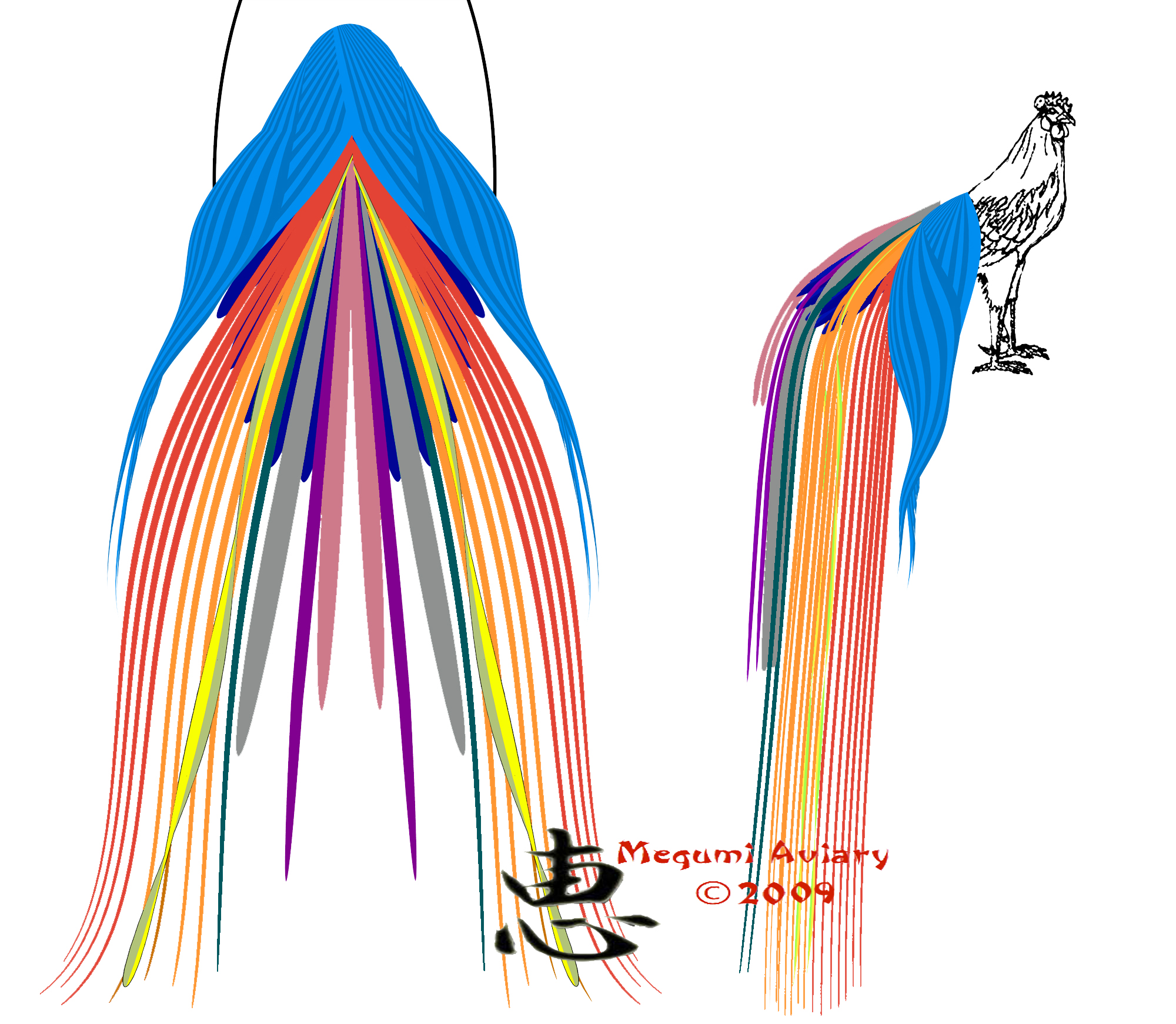
We have a color coded diagram of these feather groups. It is labeled to the best of our understanding. You may view it below or download and print this PDF.
ウワヨレ (uwayore): One pair; the uppermost covert feathers that grow in twisted fashion; do not molt
尾覆(ofuku): 3-4 pairs at top; do not molt
謡羽(utaibane): 1 pair; topmost of the dragging tail feathers (hikio); do not molt
小謡羽(sho-utaibane): 3-4 pairs at top; do not molt
コウガイ(kougai): 1 pair; altered main tail feathers at top row(?); topmost of the main tail feathers; molts yearly*
コウゲ(kouge): 1 pair: altered main tail feathers outside the row(?); molts every 3 to 4 years.
Kawari-honge (変わり本毛; also known as "kouge") is an altered feather of the main tail and is the widest, with feather shaft that is fine, elastic and strong, reaching length of around 3 meters. The number of this feather determines the quality of the Onagadori. In other words, the altered feather count can range from 1 to 4, and an individual with 4 such feathers is prized most highly.
裏尾(urao; literally “backside tail”): 1 pair; molts every 3-4 years.
Along with the altered feather, kouge, the urao (literally, back tail) also molts once every 3 to 4 years. The pair of Urao feathers is not broad but has strong and elastic shafts and can reach a length of around 3 meters. The main tail is wide and long. The daiichi-honge (literally, primary main feathers; also known as "kougai") grows 70 to 90 cm (27 to 35 in.) a year. The lower section of the sho-utaibane and ofuku molt ever year but grow with speed all year long.
蓑羽 (minoge - saddle feathers) - Minoge feathers are countless, forming a semi-cylinder ("tsutsumino").
The feathers maintain length of roughly a third of the growing tail feathers and do not molt.
本尾 (shyubi - foundation tail) These are the retrices, or main flight feathers of the tail. They molt yearly.